Due Process Is Not Theoretical
On ICE Detention, the Fight for Uriel Velasco and How Bad Bunny, Selena and Mexodus Remind Us That Art Reveals Truth

I’m a lawyer licensed in DC and Texas.
And even if I was hired to do so, I wouldn’t be able to secure a bond hearing for a man detained by ICE without due process because a recent federal court ruling stripped access to bond hearings for many detained people.
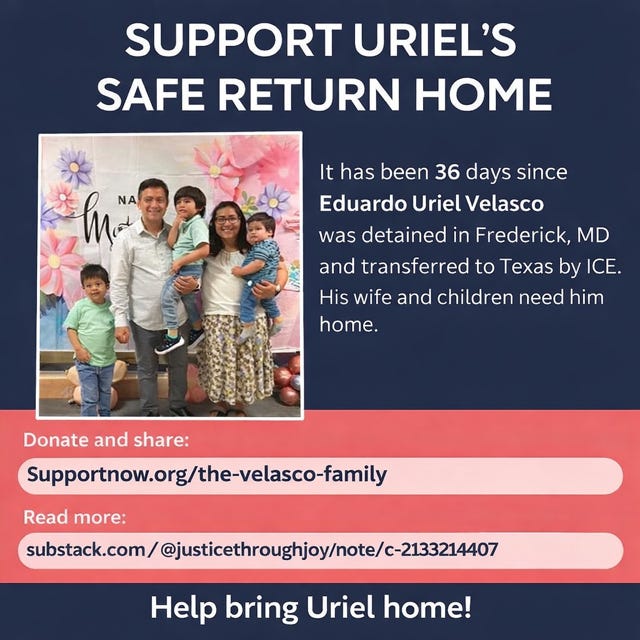
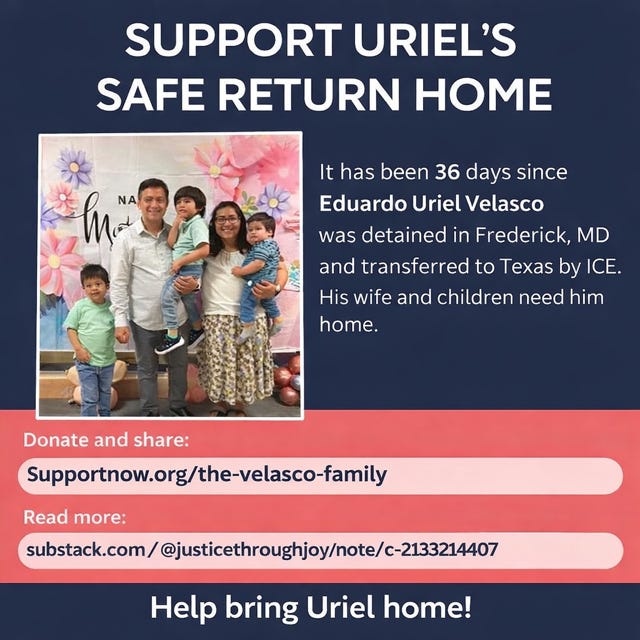
It has been 37 days since my friend’s brother-in-law, Eduardo Uriel Velasco, was detained by ICE in Frederick, Maryland — the state where he and his family live.
The same state where my wife and I live.
Eduardo Uriel Velasco was later transferred to a facility in Pearsall, Texas. Hundreds of miles from his children.
Earlier this week, his family learned that, even though his bond hearing was previously postponed several times, the new ruling is being interpreted to mean he no longer has a right to a bond hearing. Uriel is now expected to remain detained until late March with no present opportunity for release on bond. These tragedies continue happening, quietly and without adequate attention being paid to the people who are being targeted, harmed.
Uriel’s wife, children, and his family, and his larger community are devastated. They are emotionally exhausted. His three children are disabled. His wife is their full-time caregiver. They miss him in ways that are impossible to describe.
As a woman whose identity was shaped in Texas, the state where Uriel is currently being held, without the right to a hearing, it stings in a way I cannot ignore.
Identity Is Not Abstract
I have spent my life moving between identities:
I am a Mexican American woman. My identity was formed in Texas. It was in Texas, where my Mexican identity became my Mexican American identity in grade school. It was later, also in Texas, during college, that my Mexican American identity emerged as my Chicana identity. This happened over time as I learned more about our people´s history at the University of Houston.
I also navigated the struggle between being seen as and referred to as Hispanic and ultimately came to terms with my identity as a Latina when I navigated the professional working world in both Texas and Michigan where I attended law school.
Even when I began practicing law in our capital city, D.C., while I worked with older Latino adults in my functional, imperfect Spanish, they recognized me and called me a Mexicana.
I am a lawyer who has at times believed in due process.
The undocumented children I once cared for when they were detained by the Department of Homeland Security back in the early 2000s —the kids who stole my heart, begged me to adopt them, called me mama, and pushed me to become better, for them and for myself, — better in my Spanish, better in my advocacy. It is because of those kids that I finally took a risk on myself and went to law school. They made me the advocate I am today. They were children in search of safety, shelter, food, and love. They deserved a chance. It was their humanity that moved me forward.
Our elected leaders in this country, and around the world, must stand up for the humanity of all who are in this land. Elected leaders must begin to fully recognize our humanity. Uriel should be able to safely return to Maryland immediately. He should be given the opportunity for a bond hearing. This is not a partisan issue. It is a constitutional one. And more than just relying on the Constitution — a document that has often failed to protect the global majority and those not in power — due process is a moral imperative.
Uriel’s future is tied to all of ours
Incarceration, detention, imprisonment without meaningful due process is not just a paper failing. It’s families like Uriel’s waiting at the dinner table. It’s mothers caring for their children without support, while juggling the costs of life while fending off questions from her children about when their father is coming home.
Whatever they call us — immigrant, Mexican, Latina, Chicana — we are still here.
And This Is Where Art Enters The Story.
Mexodus, Selena, Benito, and the Work We’re Being Called to Do
I’ve been thinking a lot about Mexodus lately, the revolutionary live-looped hip-hop musical by Brian Quijada and Nygel D. Robinson which tells the lesser known but powerful story of thousands of formerly enslaved Black people who escaped to freedom on the Underground Railroad that went south toward freedom through Mexico.
In the summer of 2025 when I first experienced Mexodus, the play cracked something wide open inside of me, something that neither my advocacy work nor my own creative endeavors had ever done. The creative geniuses who brought Mexodus to life, Brian Quijada and Nygel D. Robinson, used live-looping, hip-hop, and memorable music, movement, and memory to tell this much-needed story. Mexodus showed me a piece of myself I hadn’t yet fully grasped, let alone seen reflected on a stage. And once I saw it, I couldn’t stop seeing the throughline.
It was a piece of my story that I saw on stage, and maybe it is a piece of yours. It is a story of Black and Brown people, who have rallied together against all odds, to form some of the most impactful and united fronts against mutual oppressors.
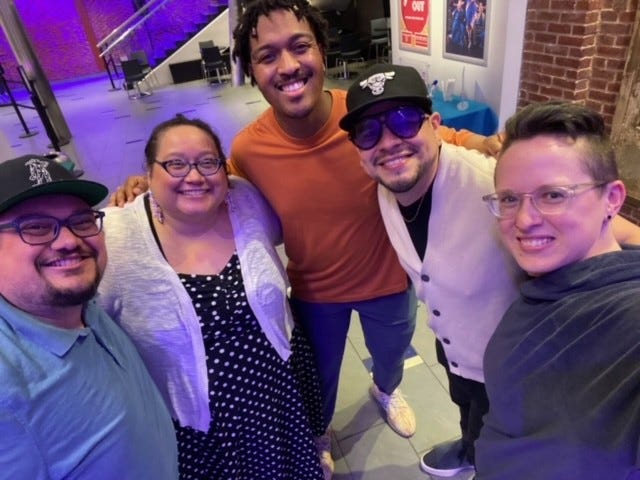
At the heart of Mexodus was both a warning and a comfort, todos estamos juntos en esto; we are all in this together. Because whether or not folks are ready to admit it, we are all in this together. This is what art does as it’s telling the truth: it reveals what history has tried to bury. It restores to us what oppressors and colonizers have tried to hide, what man-made borders tried to erase. Art connects us back to our authentic selves.
I was reminded of this truth again recently. It could not have come at a better time. Last month when I showed up to the Latino AI Summit, a national gathering of Latino technologists, founders, and storytellers, I was a bit anxious. When I first entered the virtual waiting room for a session I was co-presenting, I felt the anxiety throughout my body. I wasn’t anxious about the content—I knew the work. I was ready to share.
I was worried that a technical failure could prevent me from connecting with the community that showed up. I was nervous about potentially missing this opportunity for connection because of something small and human.
But the Latino AI Summit Founders and organizers took so much care—and the technical support and resources offered before and during—made me feel safe in a way no national conference ever has. When I showed up with questions right before we began, my concerns were handled and all I had to do was speak truth to a room of folks who wanted to hear it and receive it.
It was an emotional experience co-presenting with Jessica Barrera Sorley for Cosmic Justice: AI + Soul for Community Healing. We dove into new ways of creating with technology that honors the spirit of our communities. Jessica shared an intuitive and energetic framework behind her Cosmic Companion creation. I introduced Justice Through Joy and my model for community transformation through storytelling, connection, and community.
Later when women told me how excited they were to hear me share my story, I felt restored. One woman expressed an interest in inviting me to visit her hometown to host a storytelling workshop. She’s eager to connect with me in my Justice Through Joy work.
Another woman shared with me that the work about I spoke inspired her to better connect with telling her own story. People said when I spoke about my Mexican American experience, it resonated with them and their stories or in how they relate to loved ones.
People were interested and asked about when my Justice Through Joy podcast will be launching. No specific date yet, but for what it is worth, I am planning to launch my Front Porch Sippin and Storytellin podcast this May 2026.
These shared moments of solidarity in community have reconnected me with an important truth I’ve been moving toward for the last several years of my own recovery and my own creative, writing and storytelling work journey. My work is not about a single story I want to tell.
It’s also not about a specific angle I’m hoping to uncover or expose in my Justice Through Joy work.
It’s about a shared recognition that we all need this. It’s about that collective calling toward caring for ourselves and one another, uncovering our own truths and our stories, celebrating our wins, and mourning in community. It’s about finding whatever value we can connect to in determining whether or not, or where, why, and how, we will share our stories, when and if we feel safe enough to do so.
We are all looking for that safe space to do this work for ourselves, for our communities. I have been as intentional as possible throughout this journey of mine, but it has not been linear or easy. And finding a safe space and navigating how to do this work has required deliberate, incremental steps — especially complicated because there was not always been a clearly defined path, or any path at all.
All of this has come together beautifully most recently during a universally connective moment of truth-telling through art, when Bad Bunny won the Grammy for Album of the Year. Oh—and that gift he gave us with his half-time show filled with love and storytelling, that was the icing on that delicious cake.
As all of the worthy global recognition was directed at Benito Antonio Martínez Ocasio’s historic Grammy win, Puerto Rico was placed back at the center of many cultural conversations. And watching all eyes turn toward Puerto Rico combined with the nearly universal collective celebration that so many of us experienced while one of our own has been rightfully and globally recognized and celebrated, brought up the type of joy that art and creative endeavors can do to connect cultures. And his win reflects our shared resilience, and it reminded me of something older, something deeper.
I was reminded of Selena. I remember when I was a young girl how Selena Quintanilla Pérez, and Selena y los Dinos, at first they were ours. It felt like she at first, she was our Tejana icon. We called her La Princesa de la Onda. La Reyna.
But ultimately, she was not just for us. Not just for Tejanos. Not just for Mexican Americans. Not just for Chicanos. Selena crossed and connected cultures through her music.
Selena was for all of us.
And so is Benito.
Safety isn’t incidental. It’s what allows our authentic selves and our truths to come alive. That’s why watching Benito show up as his authentic self — representing and calling on his Puerto Rican home and New York — and calling in so many people, communities and nations felt so intimately, and vitally important. When colonizers disconnect us from language, land, and community, reclaiming joy becomes our act of resistance.
As he called in Chile, Argentina, Uruguay, Paraguay, Bolivia, Peru, Ecuador, Brasil, Colombia, Venezuela, Guyana, Panama, Costa Rica, Nicaragua, Honduras, El Salvador, Guatemala, Mexico, Cuba, the Dominican Republic, Jamaica, Haiti, Islas Antillas, United States, Canada and Puerto Rico — he was bringing all of our communities together by name and for Belize— not by name but by flag— and by having so many flags flown together, as representative of the true Americas. It was overwhelming in the best way.
Joy and discontent both live together in our lives, but Benito’s half-timeshow, our half-time show, was about love and connection. I’d previously wondered whether he would use the platform to call out ICE again. But he did much more.
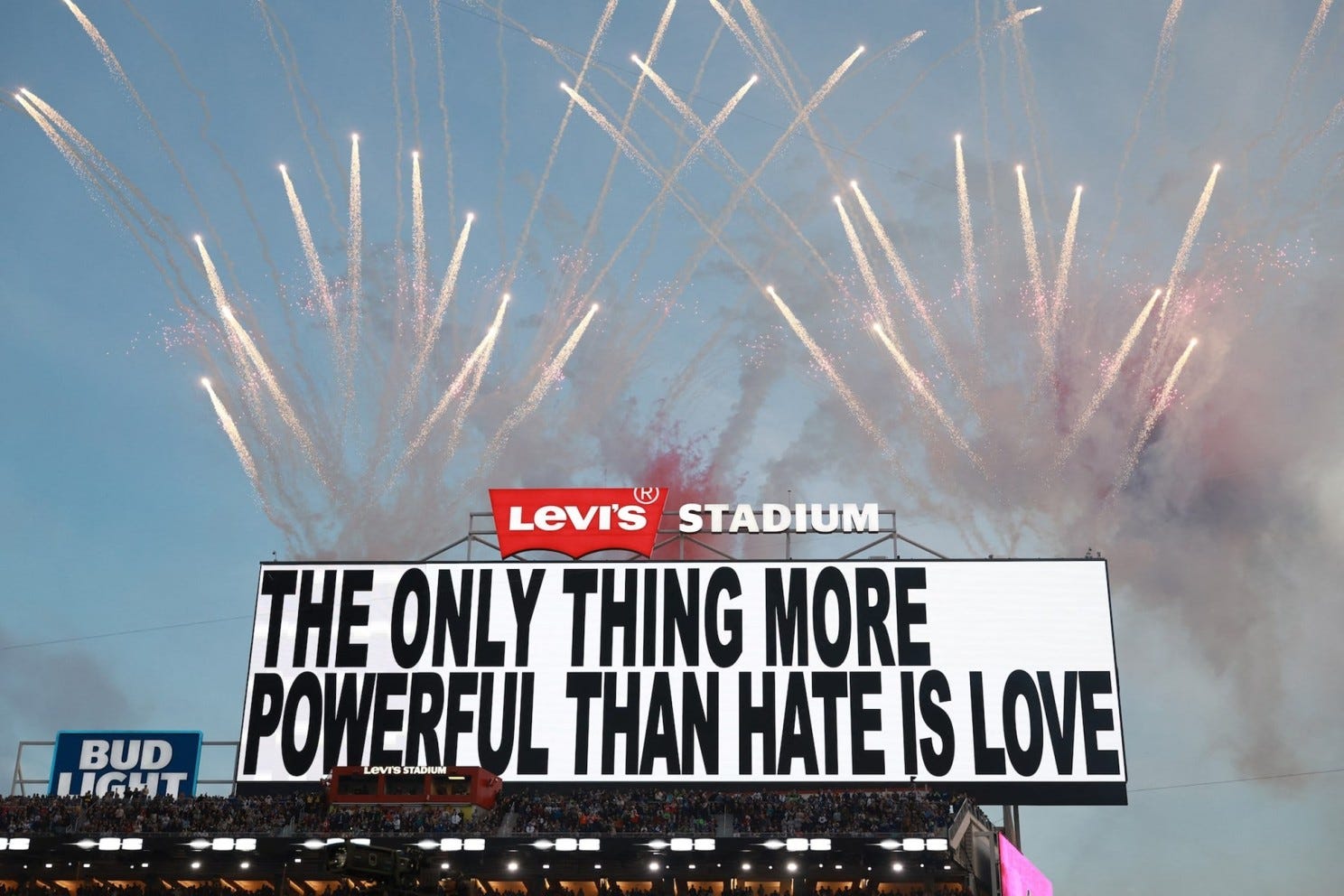
None of the noise was there. Nothing about how the government may categorize us, try to hold us back. Nothing about how the oppressors continue coming after us without reason or rhyme. It was not about how those who would deny us our full humanity have harmed us or tried to contain us. None of that mattered in that moment. It was just music. Connection. Culture. Belonging. Joy. And it was everything we needed.
He embodied love, self-love and community love. Because The Only Thing More Powerful Than Hate Is Love. And I keep returning to this truth: art shows us what policy refuses to name. Mexodus does that. Selena did that. Benito is doing that now.
And Uriel’s story reminds us of what happens when policy refuses to protect what art continues to reveal. And the work I’m doing—with Justice Through Joy, through leading in AI spaces, and in my writing, performing, and in my storytelling—it is about holding that thread steady.
Uriel’s family needs your support.
Please share his story. Please support his family in any way you can. Any contributions will support both legal advocacy and family stability while he is detained away from his family as they continue pursuing legal remedies. Your support, your time, your prayers — they are not in vain. We are determined to see Uriel return home safely. The support link will be at the end of this writing.
Support Uriel. Support Due Process. Support Storytelling That Keeps Us Visible. Seguimos Aquí. And we’re not done telling the story yet. Todos estamos juntos en esto.
In Solidarity,
Rebekah D. Mason Barrera
https://www.supportnow.org/the-velasco-family
This piece first appeared in my LinkedIn Newsletter. I’m sharing it here with audio.
This was such a refreshing and deliciously informative read - one that I desperately needed, right now. Thank you, Rebe; thank you, Substack; thank you, all resilient progressives.
Thank you for amplifying!